The Australian government is calling its under-16 social media law “world-leading” and says it has “started a global movement,” with other countries following Australia’s lead.
Before the UK copies it, parents should ask a simpler question: has the ban actually made kids safer?
The government keeps pointing to a big number: more than 5 million under-16 accounts were removed, deactivated or restricted. That sounds impressive until you read eSafety’s own March compliance update. Among parents whose child already had an account before the ban, around 7 in 10 said their child still had an account on Facebook, Instagram, Snapchat or TikTok after the rules came in. Source: eSafety March 2026 compliance update.
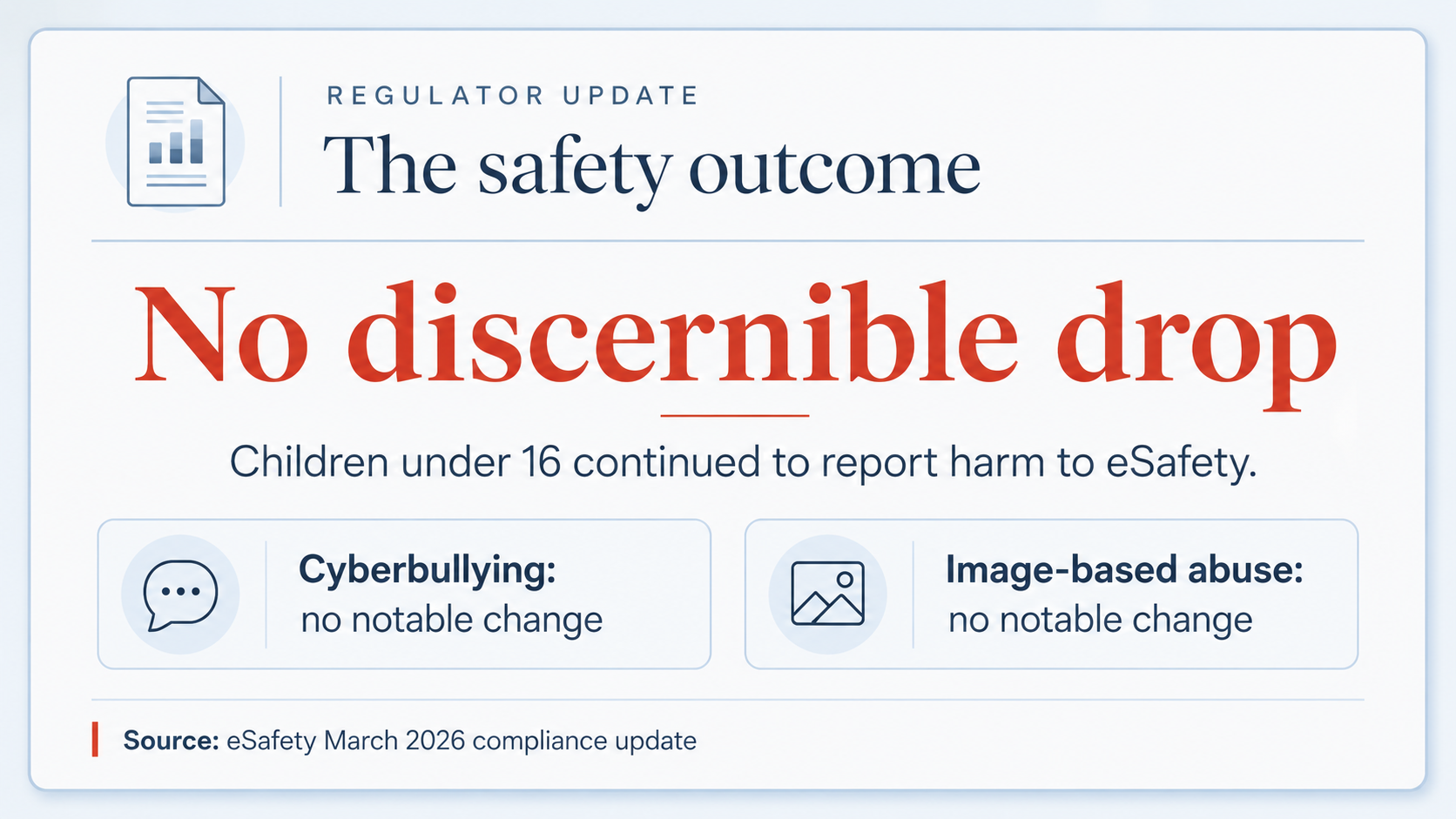
The same update says children under 16 continued to report harm to eSafety, with no discernible drop in overall numbers. It also says eSafety had not observed a notable change in cyberbullying or image-based abuse complaints involving age-restricted accounts compared with the same period in 2025. Source: eSafety March 2026 compliance update.
By late June, no social media company had been fined. Instead, the government was moving to strengthen enforcement by doubling potential penalties and giving eSafety greater powers to require information from platforms. Source: ABC News.
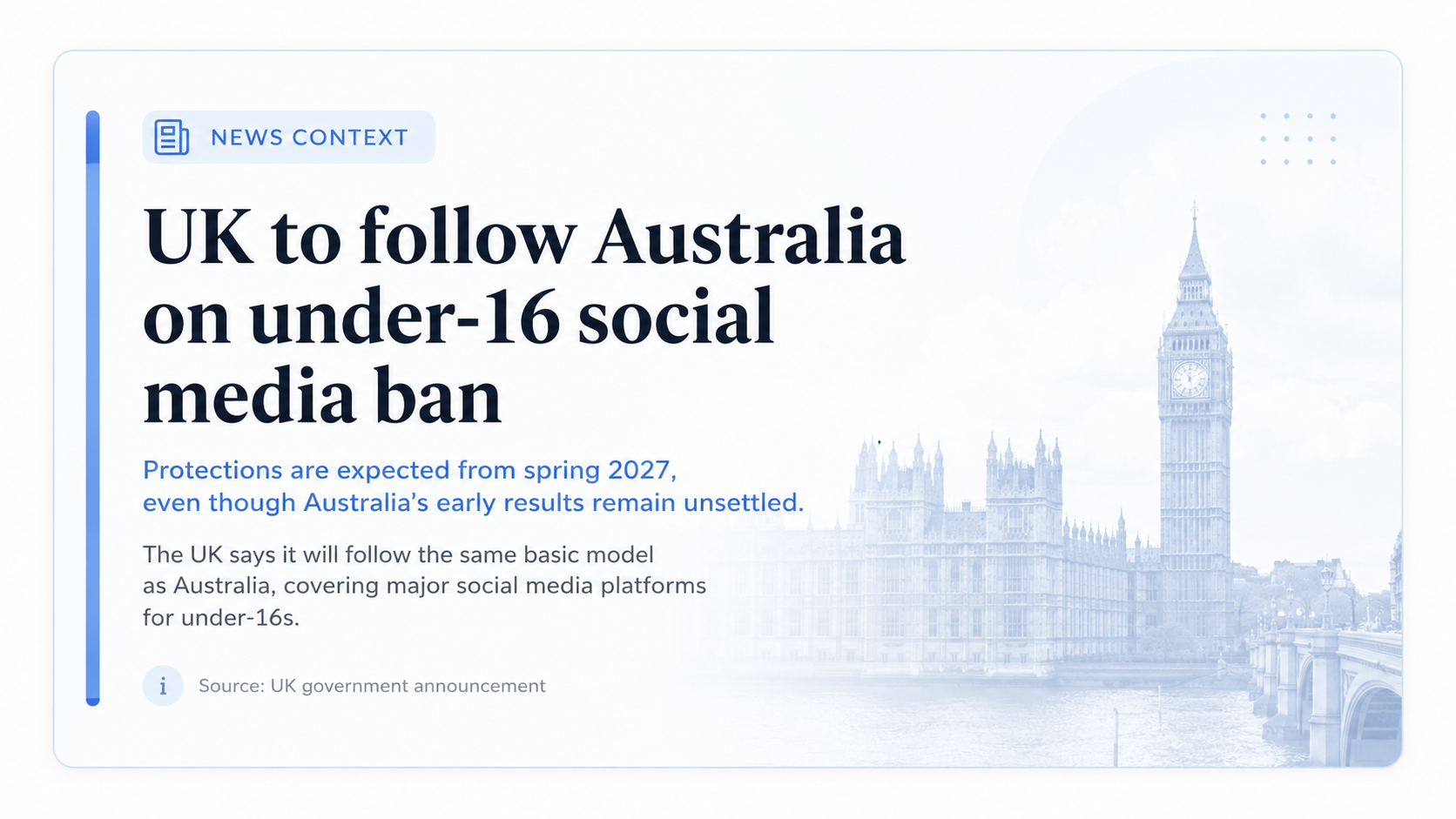
And now the UK wants to move in the same direction. The UK government announced that social media platforms would be banned from offering services to under-16s, with protections expected to come into force in spring 2027. The government says it plans to use the same model as Australia, covering Snapchat, TikTok, YouTube, Instagram, Facebook and X, while leaving messaging services like WhatsApp and Signal outside the main ban. Source: UK government announcement.
So the question is not just whether Australia’s ban is working: it is whether other countries should copy it before Australia has proved it works.
The scoreboard parents should care about
Australia’s social media minimum age law came into effect on 10 December 2025. The idea was simple enough: age-restricted platforms need to take reasonable steps to prevent Australians under 16 from creating or keeping accounts. The onus is on the platforms, not kids or parents. Source: Australian Government.
I am not against delaying social media. I think most kids are better off waiting. If a law gives parents more confidence to say “not yet,” that can be useful. But we should not confuse delay with safety, and we should not let a big account-removal number distract us from whether the policy is actually working.
eSafety’s own numbers are the issue. The March update says the proportion of children with at least one social media account dropped after the law came in, so yes, something changed. But among kids who already had accounts before the restrictions, around 7 in 10 still had accounts on Facebook, Instagram, Snapchat and TikTok. That is not a small leak. That is the core group the policy was meant to reach.
That is the stat I would put in front of every UK policymaker thinking about copying Australia. If 7 in 10 kids with existing accounts are still there, and the most common reason is that the platform never asked them to verify their age, then the policy is not landing where it needs to land. *I should point out that for my son and his group of friends, with Snapchat, the platform did age verify them as it should, the problem is that this age check was easily defeated and the group has left iMessages for Snapchat again.
The government is measuring the wrong thing
The government likes the “millions of accounts” line because it sounds decisive. eSafety reported that 4.7 million age-restricted accounts were removed or restricted by mid-December, and the government later pointed to more than 5 million accounts removed, deactivated or restricted. Source: eSafety March 2026 compliance update.
This is like putting a security sticker on a house with no locks. It may tell us platforms did something. It does not tell us the policy has made children safer.
The scoreboard should be different.
- Did cyberbullying go down?
- Did image-based abuse go down?
- Did unwanted adult contact go down?
- Are fewer kids being pushed toward self-harm content?
- Are fewer kids being exposed to drug content, sexual pressure, hacking attempts or scams?
- Are fewer kids losing sleep because of compulsive design and group chat pressure?
If the answer is “we do not know yet,” then say that. I would respect the honesty and I understand some of these questions are hard to measure. What I do not like is the account-removal theatre being treated as child safety.
I have a second big concern: where are the metrics we actually need? I have tried to locate them on government websites and publications, but there doesn't seem to be a reporting framework that is being used to track the performance of the social media ban.
The reported harm figures have not moved yet
This is the part I cannot get past. eSafety’s March update says children under 16 continued to report harm, with no discernible drop in overall numbers. It also says there was no notable change in cyberbullying and image-based abuse complaints involving age-restricted accounts across the platforms in January and February 2026 compared with the same period in 2025. Source: eSafety March 2026 compliance update.
That does not prove the law will never have an effect. It is early. But it does prove we should be careful about declaring success. If the whole point is wellbeing, then harm reports matter more than the number of accounts a platform says it removed.
As a parent, that is the test. Not whether the press release sounds tough. Not whether other countries are impressed. Are the things we worry about actually reducing.
What has eSafety been doing?
Their March update lists the activity:
- More than 760 submissions and enquiries
- A survey of 898 parents
- 23 information-gathering notices to 10 platforms
- Five investigations into Snapchat, TikTok, Facebook, Instagram and YouTube
Source: eSafety March 2026 compliance update.
But if you step back, is that a lot? I don’t know their budget. I don’t know their staffing. My first thought when I read that: I felt underwhelmed. It does not look like a serious enforcement machine moving quickly on a major national initiative.
A survey of 898 parents is useful, but it is still a survey. Issuing 23 information requests sounds official, but it is still paperwork unless it leads somewhere. “Commencing investigations” sounds serious, but parents deserve to know what that actually produced.
The number that should have triggered action was eSafety’s own finding that around 7 in 10 children with existing accounts still had accounts on Facebook, Instagram, Snapchat or TikTok after the rules came in. If that is the regulator’s own finding, then the next public update should be obvious: what did eSafety do about it?
Were the platforms forced to remove more underage accounts. Were parent reports acted on. Were the investigations finalised. Were any companies found non-compliant. Were any fines issued.
By late June, the public answer seemed to be no. ABC reported that no social media company had been fined, and the government was moving to double penalties and give eSafety stronger powers to demand documents, including internal emails and board minutes. Source: ABC News.
That is the part I find so frustrating. If the problem is enforcement, start enforcing. If platforms are not asking kids to verify their age, act on that. If parent reports are not being handled properly, publish what is happening and what is being fixed.
Why is eSafety now asking for greater powers to impose larger enforcement fines? They haven’t yet issued the first fine. You do not need a bigger headline fine if you have not issued the existing fines. You need a regulator that reports clearly, moves quickly, and shows parents what changed after its own data revealed the ban was not reaching the kids it was meant to reach.
The first hurdle is age checking
The age-check problem has not gone away. Reuters reported in July that a team of software testers opened 50 accounts after the law came into force, declared the users were 16, and were not asked for age proof by the platforms tested. All 50 test accounts were active, and only Kick refused to let users create an account without proof of age. Source: Reuters.
That is a practical problem, not an academic one. If a child can create or keep an account by entering the right birthday, then the policy starts to look like a speed bump. Maybe useful for younger kids. Maybe useful for some families. But not a serious safety wall for 13, 14 and 15 year olds who already understand how these systems work.
The platforms say they are using layered checks and will escalate to stronger age verification when behaviour suggests a user may be underage. That might improve over time. But parents should not be asked to treat “maybe it works later” as protection now.
The UK should pause before copying Australia
The UK government has announced plans to ban social media platforms from offering services to under-16s, with protections expected to come into force in spring 2027. The UK says it plans to cover platforms like Snapchat, TikTok, YouTube, Instagram, Facebook and X, while not intending to include messaging services like WhatsApp and Signal. It also says it wants to go further by restricting livestreaming and stranger communication with children across a wider range of services, including gaming sites. Source: UK government announcement.
I understand why that sounds good to parents in Britain. It sounded good to a lot of parents here too. The problem is that Australia has not proven the model works yet.
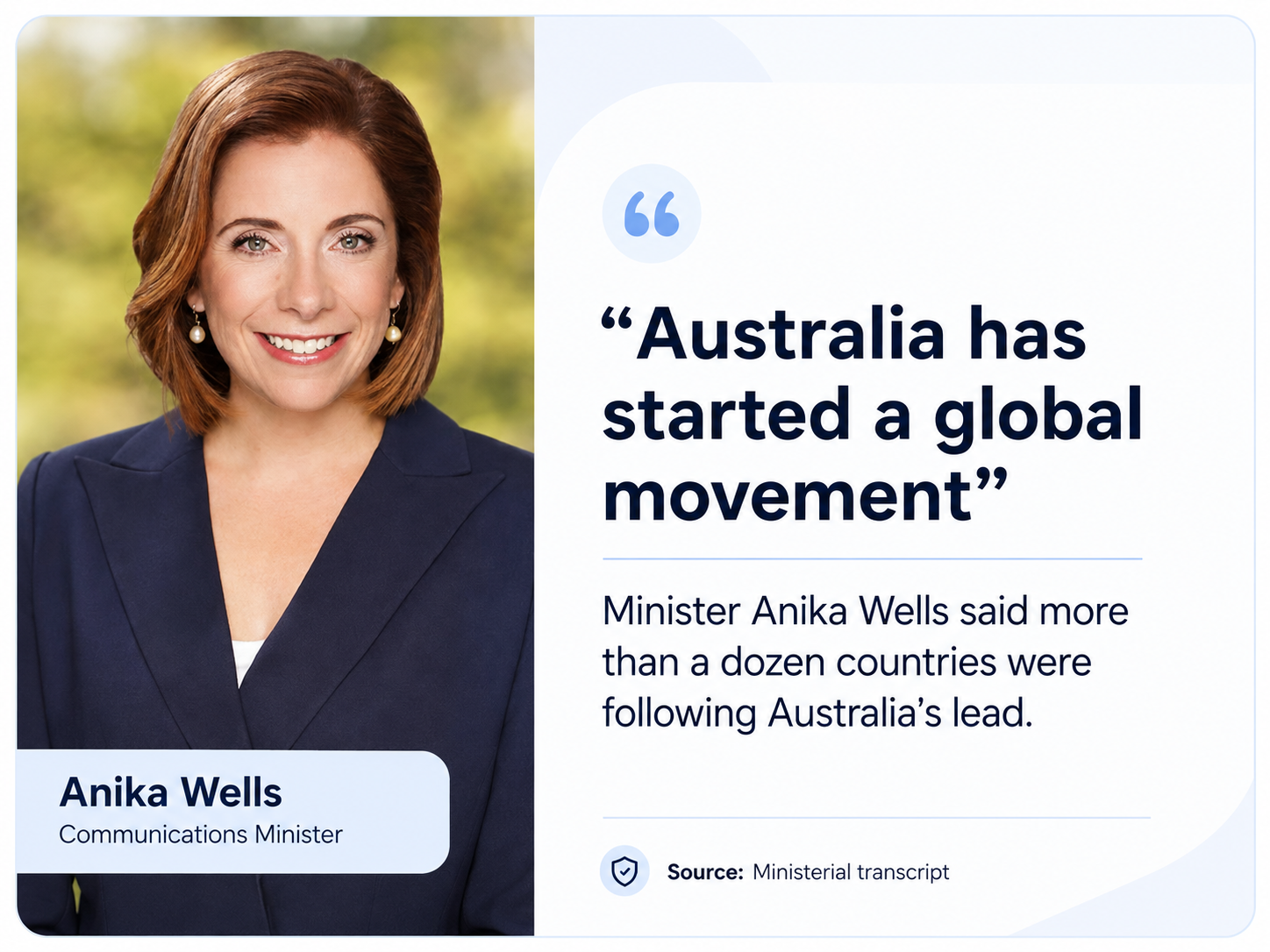
Minister Anika Wells said in March that “Australia has started a global movement” and that more than a dozen countries were following Australia’s lead. Source: Ministerial transcript.
Maybe that is true politically. But I think other countries should wait for the evidence before copying the model. If the best early data says 7 in 10 kids with existing accounts are still there, harm reports have not clearly dropped, and enforcement is still trying to find its teeth, why rush.
The evaluation is useful, but it is not a live scoreboard
eSafety has launched a major evaluation of the law. It will follow more than 4,000 children and families for more than two years, using surveys, interviews, group discussions, opt-in smartphone-use tracking, and linked population-level data like education and health outcomes. It will look at wellbeing, mental health, exposure to online risks and harms, digital habits, help-seeking, family relationships, parenting experiences and compliance. Source: eSafety evaluation.
That is useful research. I am glad it exists. But it is not the same as a live public scoreboard for parents.
It will take time. Findings are expected progressively from later in 2026, with deeper analysis over time. The legislative review is scheduled to begin in 2027. That means Australia is already selling the policy as a global model before the wellbeing evaluation has landed.
As a parent, that feels backwards. Run the evaluation. Publish the results. Show what changed. Then tell the world what worked.
Why parents like bans
I understand why parents cheer for a ban. The problem feels huge, and a ban gives us a clean answer. No TikTok. No Snapchat. No Instagram. Done.
But kids’ online lives do not live neatly inside those app names. Messaging, group chats, gaming, disappearing messages, private accounts, screenshots, fake birthdays, second accounts and workarounds all keep moving. The risk does not disappear just because one doorway gets harder to open.
The risks parents care about are still there: bullying, predators, hacking, addiction, distraction, sleep disruption, image pressure, group chat cruelty and kids being exposed to things they are not ready for. If the policy does not reduce those harms, then it is not enough.
What parents should do with this
I am not saying parents should give kids social media early. I am not saying the platforms are doing enough. They are not. I am not saying government has no role. It does.
I am saying a ban is not a parenting strategy.
If the ban helps you delay social media, use it. If it gives you cultural backup to say “not yet,” great. I like that part. But do not stop there. Your child still needs judgement. They still need scripts. They still need to know what to do when someone sends a creepy message, asks for a photo, starts a pile-on, or moves a conversation somewhere private.
And you still need ways to notice when something changes. Not a full-time surveillance operation, just enough signals to ask better questions: who is this new person, why has that group chat suddenly exploded, why did a close friendship go quiet, etc. This is the part a ban does not solve.
Sources
Australian Government: Social media minimum age
Used for the legal basics of the Australian law: platforms must take reasonable steps to prevent Australians under 16 from having accounts, and responsibility sits with the platforms rather than children or parents.
https://www.infrastructure.gov.au/media-communications/internet/online-safety/social-media-minimum-age
Prime Minister of Australia: “4.7 million accounts deactivated, removed or restricted”
Used for the government’s claim that the law is “world leading” and that 4.7 million under-16 accounts had been deactivated, removed or restricted shortly after commencement.
https://www.pm.gov.au/media/4-7-million-accounts-deactivated-removed-or-restricted
Prime Minister of Australia: Press conference, Murarrie
Used to verify the Prime Minister’s “world leading legislation” language and the early 4.7 million account figure discussed alongside the eSafety Commissioner.
https://www.pm.gov.au/media/press-conference-murarrie
Minister Anika Wells: Press conference, Canberra
Used for the “Australia has started a global movement” quote, the 5 million account figure, and the statement that several major platforms were under investigation.
https://minister.infrastructure.gov.au/wells/transcript/press-conference-canberra-1
eSafety Commissioner: Social media age restrictions
Used for the regulator’s official implementation hub and March 2026 compliance update.
https://www.esafety.gov.au/about-us/industry-regulation/social-media-age-restrictions
eSafety Commissioner: Social Media Minimum Age compliance update, March 2026
Used for the key evidence in this article: around 7 in 10 children with existing accounts still had accounts on Facebook, Instagram, Snapchat or TikTok after the rules came in; platforms often had not asked children to verify age; children under 16 continued to report harm; and eSafety had not observed a notable change in cyberbullying or image-based abuse complaints involving age-restricted accounts.
https://www.esafety.gov.au/sites/default/files/2026-03/SocialMediaMinimumAgeComplianceUpdateMarch2026.pdf?v=1774932849355
eSafety Commissioner: Social media age restrictions evaluation
Used for details of the long-term evaluation: more than 4,000 children and families, over more than two years, with wellbeing, mental health, digital habits, exposure to online risks and harms, help-seeking, family relationships, parenting experiences and compliance being assessed.
https://www.esafety.gov.au/research/social-media-age-restrictions-evaluation
UK Government: Social media to be banned for under-16s
Used for the UK policy announcement: the UK plans to use the same model as Australia, expects protections from spring 2027, and intends to cover platforms including Snapchat, TikTok, YouTube, Instagram, Facebook and X while excluding messaging apps like WhatsApp and Signal from the main ban.
https://www.gov.uk/government/news/social-media-to-be-banned-for-under-16s-in-landmark-government-move-to-givekids-their-childhood-back
UK Government fact sheet: New rules to protect children online
Used to cross-check UK policy detail, including the Australia-style model, the likely included platforms, and the exclusion of WhatsApp and Signal from the main social media ban.
https://www.gov.uk/government/publications/fact-sheet-new-rules-to-protect-children-online/fact-sheet-new-rules-to-protect-children-online
ABC News: Sensitive documents target of Australia’s social media age ban crackdown
Used for reporting that no social media company had been fined by late June and that the government was moving to double penalties and give eSafety stronger powers to demand documents.
https://www.abc.net.au/news/2026-06-30/social-media-age-ban-fines-raised-for-tech-giants/106858306
Reuters: Australia’s teen social media ban fails to clear first hurdle in age checks
Used for the age-check testing point: 50 test accounts declared age 16, and the tested platforms did not ask for proof of age.
https://www.reuters.com/world/australias-teen-social-media-ban-fails-clear-first-hurdle-age-checks-says-study-2026-07-07/
The Guardian: Australia to double penalty for social media ban breaches to $99m
Used for additional reporting on the government’s proposed penalty increase and the broader critique that platforms were still letting too many children bypass the ban.
https://www.theguardian.com/australia-news/2026/jun/27/australia-under-16-social-media-ban-tech-companies-penalty-double
The Guardian: Australia’s teen social media ban is a flop
Used as an opinion source for the critique that many experts warned against the policy before it passed, and that the government moved ahead despite unresolved evidence concerns.
https://www.theguardian.com/commentisfree/2026/apr/01/australia-teen-social-media-ban-criticism
University of Newcastle: Australia’s social media age restrictions show limited early impact
Used for the early research finding that many adolescents were still using restricted social media platforms after the law came into force.
https://www.newcastle.edu.au/news/2026/06/australias-social-media-age-restrictions-show-limited-early-impact-new-research-finds
Related features: Smart Alerts, How’s My Child?, and Contact Verification.