On 31 July 2026, Australia’s online safety regulator, the eSafety Commissioner, released its first three-month evaluation of the country’s under-16 social media restrictions. The rules require covered platforms, including Facebook, Instagram, Snapchat, TikTok and YouTube, to take reasonable steps to stop Australians under 16 from creating or keeping accounts.
On the same day, eSafety Commissioner Julie Inman Grant published a blog titled “Key developments show eSafety’s holistic approach is working.” She pointed to eSafety starting court proceedings against Telegram, Google rolling out new age-signal technology in Australia, and Apple announcing new child-safety features as signs of progress.
I read eSafety’s three-month evaluation and Inman Grant’s blog, and I am not only a frustrated parent, I feel really let down by our government.
The evaluation contains two findings that I think every parent should know. 81.5% of kids in the study were still using social media platforms covered by the restrictions, while parents were becoming less aware of their children’s social media use.
Yet at the same time, the Commissioner is pointing to Telegram, Google and Apple as evidence that Australia’s broader approach is working. How can eSafety’s own report show that more than eight in ten kids are still using social media and parents are becoming less aware, while the Commissioner is simultaneously presenting these other developments as evidence of success?
That is what I wanted to look at more closely. Are Telegram, Google and Apple really evidence that Australia’s social media restrictions are working, or are useful but largely separate developments being pulled into a convenient success story?
81.5% of kids ARE still using social media
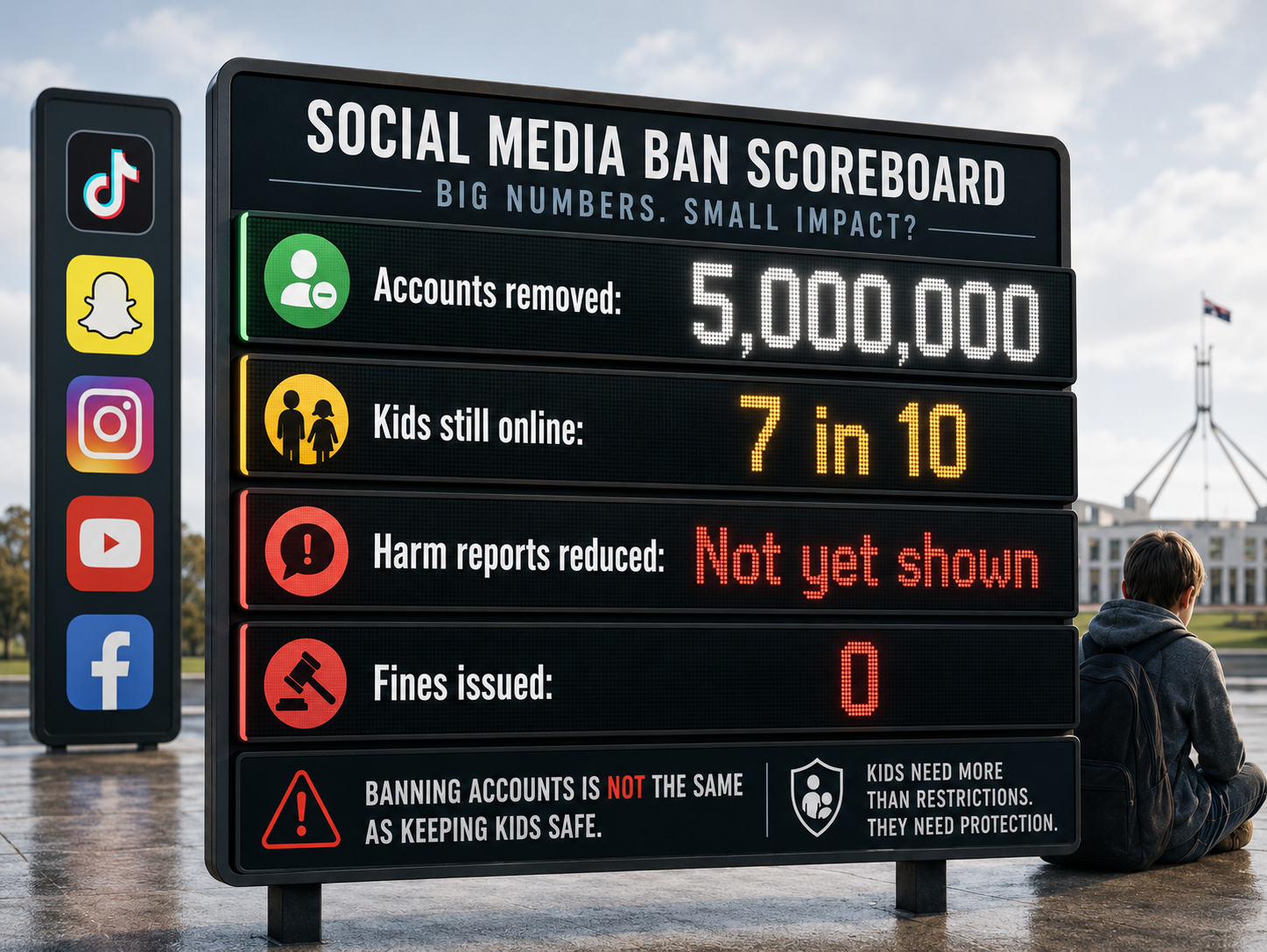
The government has spent months talking about how many under-16 accounts have been removed, deactivated or restricted. Prime Minister Anthony Albanese later put that figure at more than five million. Source: Prime Minister of Australia.
Five million sounds enormous, but as a parent I care about a much simpler question: are kids actually still using social media? eSafety’s new evaluation gives us a much clearer answer.
At the three-month follow-up, 81.5% of children aged 10 to 15 in eSafety’s study reported using at least one social media platform covered by the restrictions during the previous four weeks. Before the restrictions came into effect, the figure was 85.9%. Source: eSafety three-month report.
So yes, use fell a little, but more than eight in ten kids in the study were still using social media. That is the number I care about, not how many accounts a platform says it deleted or how impressive the government announcement sounds.
I want to know whether kids are actually still there, using the platforms and being exposed to the same online world parents were worried about before the ban. For most of the kids in this study, the answer was yes.
That is why I have always been uncomfortable with the five-million-account figure being used as such a strong measure of success. It makes a great headline, but it tells parents very little about whether children actually stopped using social media or whether the risks we care about have reduced.
Parents are becoming less aware of their kids’ social media use
The second finding concerns me even more. Among children in the study who said they had used social media in the previous four weeks, the proportion of parents who did not know about that use rose from 23.3% to 33.3%.
Before the restrictions, just under one in four parents were unaware their child had been using social media. Three months later, it was one in three. Source: eSafety three-month report.
The report does not prove the ban has made parents complacent, and I do not think we should pretend it does. eSafety says there are several possible explanations, including kids concealing their use more and parents being unusually alert before the restrictions because of all the publicity around the new law.
But eSafety raises another possibility itself:
“Some parents may simply assume their children aren’t using social media.”
That possibility really stood out to me because it makes intuitive sense as a parent. A lot of families supported the ban because it promised to make an extremely difficult part of parenting easier. If the law says the platforms are responsible for keeping your child out, it is understandable that some parents might relax a little and assume the problem has largely been handled.
I can see how easily that could happen in our house too. The problem is that 81.5% of kids in the study were still using social media.
The report does not prove the ban is giving parents false confidence, but it does reveal a serious possible unintended consequence: kids are still online while their parents know less about it. For me, that is the most important finding in this new report.
eSafety itself warns that lower parental awareness may reduce opportunities for parents to support their children when something goes wrong online. Source: eSafety three-month report.
The whole point of the ban is supposed to be making kids safer. If one of its unintended effects is that some parents feel less need to look, ask and stay involved, that deserves a lot more attention.
[[ARTICLE38_PARENT_AWARENESS_CARD]]
So why is eSafety saying the approach is working?
This is where my frustration with the government really starts.
On the same day eSafety published these results, Commissioner Julie Inman Grant published a blog arguing that recent developments showed Australia’s “world-leading, holistic approach” was working. The examples she highlighted were eSafety starting Federal Court proceedings against Telegram, Google rolling out its new Play Age Signals API in Australia, and Apple announcing new child-safety features.
At face value, that sounds pretty impressive. But alongside an evaluation showing that 81.5% of kids in the study were still using social media and parents were becoming less aware of it, I wanted to understand whether those three examples actually support the success story being presented.
When you look at them individually, I think the picture becomes much less convincing.
Telegram is real action, but it is not enforcement of the social media ban
Let me start with the example where I think eSafety deserves genuine credit. The regulator has commenced civil penalty proceedings in Australia’s Federal Court against Telegram, which in plain English means it has started a court case alleging that Telegram breached Australian online-safety rules and is asking the court to impose penalties. The court has not yet decided whether Telegram broke the law.
The case followed a year-long investigation. eSafety alleges that Telegram failed to detect, remove, disrupt and deter pro-terror material, including videos of terrorist executions and mass shootings. Source: eSafety Telegram proceedings.
This is the kind of regulatory action I wanted to see. Investigate a platform, identify what you think it has failed to do, and then actually take action.
There is, however, a really important distinction. Telegram is not being taken to court for breaching Australia’s under-16 social media restrictions.
Telegram is primarily a messaging service, and the proceedings arise under a different part of Australia’s Online Safety Act called the Relevant Electronic Services Standard. That standard deals with how messaging and other covered services respond to certain seriously harmful and illegal material. Source: eSafety Telegram proceedings.
In this case, the alleged failures concern terrorist content, not under-16 social media accounts. So yes, this is real enforcement and eSafety should get credit for it, but it is enforcement under a different part of Australia’s online-safety laws, about different behaviour, against a messaging service.
It does not show that eSafety has successfully enforced the under-16 restrictions against the major social media platforms the ban is targeting. When the three-month evaluation was released, eSafety’s investigations into Facebook, Instagram, Snapchat, TikTok and YouTube were still ongoing. Source: eSafety early insights release.
That is the enforcement question I want answered. If these platforms are failing to keep under-16s out, what has eSafety found and what is it doing about it?
The Telegram case is important, but it does not answer that question.
Google is a convenient success story. The public evidence is missing.
Julie Inman Grant makes an even stronger claim about Google.
Google is rolling out something called the Play Age Signals API in Australia. In plain English, it is technology that can allow an app to receive a broad age-range signal for a child using Google’s parental-control service, Family Link, if the parent chooses to share that information.
Inman Grant wrote:
“It is no coincidence that Australia has been chosen as a pilot market for both upgrades.”
That is a pretty clear implication that Australia’s regulatory approach helped cause Google to develop or deploy this technology, and that its arrival here is evidence the Australian approach is working.
So I went looking for Google’s side of the story. I could not find any public statement from Google saying Australia’s social media ban caused it to create the Age Signals API or caused its global rollout.
Google’s own announcement says the API was already available in Brazil. Australia and Canada are the next rollout markets, followed by a broader global rollout later in 2026. Source: Google Android Developers.
That matters because Australia was not where this technology started. Google was also publicly proposing privacy-preserving age signals, centralised parental controls and developer responsibility in March 2025, while its own support material describes related work responding to legislation in places including Texas and other US states. Source: Google public-policy proposal and Google Play developer guidance.
None of that proves Australia had no influence. Maybe the Australian law helped move us up Google’s rollout list, or perhaps it influenced the timing of the Australian release. But that is a much narrower claim than suggesting this technology exists as a positive spillover from Australia’s social media restrictions.
This feels a bit too convenient for me. The government spent months pointing to millions of removed accounts as proof that the ban was working. Now Google rolls an existing global product into Australia and eSafety presents that as another sign that its approach is succeeding, despite the public evidence for that causal connection being missing.
There is also a big practical limitation that I think parents should understand: the Age Signals API is optional.
Google says a child’s age range is not shared by default. A parent using Family Link chooses whether to share it, an app developer chooses whether to integrate the API, and the app then decides what it actually does with the information. Source: Google Android Developers.
Google Play also says it does not mandate developer use of the API, while eSafety’s own blog acknowledges that social media platforms may choose not to accept these age signals. Source: Google Play developer guidance.
So in practice, Google makes an age signal available, a parent chooses whether to share it, an app chooses whether to request it, and then the app chooses what to do with it. I actually like the idea and would much rather Google and Apple provide privacy-preserving ways to share a broad age range than force every family through invasive identity checks.
But we should call it what it is. It is useful technology that platforms can choose to use. It is not enforcement, it is not proof that kids have been removed from social media, and I cannot find public evidence that Australia’s ban caused Google to build it.
[[ARTICLE38_JULIE_GOOGLE_QUOTE_CARD]]
Apple is the strongest of eSafety’s three examples
Apple is different because there is actually an attributed statement connecting some of its recent work to Australia.
Prime Minister Anthony Albanese says Apple chief executive Tim Cook called him and said Apple’s latest child-safety changes were “in part inspired” by Australia’s social media age restrictions, alongside Apple’s own research. Source: Prime Minister of Australia.
That is much stronger evidence than we have for the Google claim. If Tim Cook told the Prime Minister that Australia influenced some of Apple’s thinking, I am comfortable accepting that Australia probably did help influence some of the latest changes.
And if our law helped push Apple to build better child-safety tools, great. I am happy to give the government credit for that, but the claim still needs to stay in proportion.
Apple did not suddenly start building child-safety technology because Australia passed this law. In June 2025, six months before the Australian restrictions took effect, Apple had already publicly announced a broader set of child-safety tools, including its Declared Age Range API, a privacy-focused tool that lets an app request a child’s broad age range without automatically receiving their exact birth date.
Those tools were already building on years of Apple features such as Child Accounts, Family Sharing, Screen Time and Communication Safety. Source: Apple, June 2025 and Apple Developer, June 2025.
Apple announced further child-safety improvements in June 2026, including simpler child setup, Ask to Browse, Time Allowances, contact approval controls and expanded Communication Safety. Apple says those developments were informed by guidance from online-safety and health experts, and its own announcement does not say Australia caused them. Source: Apple, June 2026.
So this one is more nuanced. There is credible evidence that Australia influenced some of Apple’s latest thinking, and there is also clear evidence that Apple’s broader work on age ranges and child safety was already well underway.
Both can be true.
Useful developments are not the same as proof the ban is working
When I step back from all of this, there are things here that I genuinely like. Telegram is facing a serious court case, Google is offering privacy-preserving age signals, and Apple is continuing to improve parental controls and child-safety features.
I support all of that. What I do not support is bundling those developments together and treating them as proof that Australia’s under-16 social media restrictions are working.
The actual evaluation of those restrictions says that 81.5% of kids in the study were still using covered social media platforms, while parents were becoming less aware of that use. Those are not side issues. They go directly to whether this policy is doing what parents think it is doing.
It is completely reasonable for eSafety to say that three months is too early to know whether the restrictions will ultimately reduce online harm. Social behaviour is complicated and some outcomes will take time to emerge, so I accept that we do not yet have the final verdict on this policy.
But if it is too early to judge the uncomfortable results, it is also too early to claim victory every time a technology company announces something useful.
You cannot have it both ways.
What I would take from this as a parent
I still want the social media restrictions to work. I think delaying social media can help families, and I understand why so many parents welcomed a law that gives them some backup when they say “not yet.”
But this new report should make us more alert, not less. I would not assume my child is off social media just because the law says they should be, and I would not assume a platform checked their age properly or that an account that was removed stayed removed.
For our family, I would keep doing the same basic things we were doing before the ban: talking, checking how the phone is set up, asking which apps are being used, noticing new contacts and staying interested when something changes. Not because I want to police every message, but because I do not think parents can outsource this job to a law or a platform yet.
The finding I keep coming back to is simple: more than eight in ten kids in eSafety’s study were still using social media, while parents were becoming less aware of it.
That is not a reason to panic. It is a reason to stay curious, calm and involved.
[[ARTICLE38_FAMILY_CHALLENGE_CTA]]
Sources
Australian Government: Social media minimum age
Used to explain how Australia’s under-16 social media account restrictions work and the responsibility placed on covered platforms.
https://www.infrastructure.gov.au/media-communications/internet/online-safety/social-media-minimum-age
eSafety Commissioner: Early days, early insights, three-month report
The primary source for social media use, parental awareness, early outcomes and the report’s limitations.
https://www.esafety.gov.au/sites/default/files/2026-07/Early-days-early-insights-SMMA-evaluation-three-months-July-2026.pdf
eSafety Commissioner: Early insights from eSafety’s comprehensive evaluation project
Used for eSafety’s public summary of the evaluation and the ongoing investigations into Facebook, Instagram, Snapchat, TikTok and YouTube.
https://www.esafety.gov.au/newsroom/media-releases/early-insights-from-esafetys-comprehensive-evaluation-project
Julie Inman Grant: Key developments show eSafety’s holistic approach is working
Used for the Commissioner’s argument that Telegram, Google and Apple demonstrate the broader approach is working, including the “no coincidence” statement about Google’s rollout.
https://www.esafety.gov.au/newsroom/blogs/key-developments-show-esafetys-holistic-approach-is-working
eSafety Commissioner: Civil penalty proceedings against Telegram
Used for eSafety’s allegations against Telegram, the status of the Federal Court proceedings and the separate legal framework under which the case is being brought.
https://www.esafety.gov.au/newsroom/media-releases/esafety-commences-civil-penalty-proceedings-against-telegram-over-alleged-failings-to-tackle-terror
Google: Delivering safer, age-appropriate experiences on Google Play
Used for Google’s description of the Play Age Signals API, its existing availability in Brazil, its rollout to Australia and Canada, the planned global rollout, parent choice and developer control.
https://developer.android.com/blog/posts/delivering-safer-age-appropriate-experiences-on-google-play
Google: Legislative proposal for keeping kids safe online
Used to establish that Google was publicly proposing privacy-preserving age signals and centralised parental controls in March 2025.
https://blog.google/company-news/outreach-and-initiatives/public-policy/google-legislative-proposal-for-keeping-kids-safe-online/
Google Play: Changes for upcoming app-store laws
Used to confirm that Google’s age-signal work also responds to legislation in Texas and other US states, and that Google Play does not mandate developer use of the API.
https://support.google.com/googleplay/android-developer/answer/16569691?hl=en
Prime Minister of Australia: Major announcement by Apple
Used for the government’s statement that more than five million under-16 accounts had been removed, deactivated or restricted, and Anthony Albanese’s account of his discussion with Apple chief executive Tim Cook.
https://www.pm.gov.au/media/major-announcement-apple
Apple: Child-safety tools announced in June 2025
Used to establish Apple’s child-safety roadmap before the Australian restrictions commenced, including Child Accounts and privacy-preserving age-range sharing.
https://www.apple.com/au/newsroom/2025/06/apple-expands-tools-to-help-parents-protect-kids-and-teens-online/
Apple: Declared Age Range API announced for developers in June 2025
Used to confirm that Apple publicly introduced its Declared Age Range API before the Australian restrictions took effect.
https://www.apple.com/au/newsroom/2025/06/apple-supercharges-its-tools-and-technologies-for-developers/
Apple: New child-safety features announced in June 2026
Used for Apple’s latest child-safety features and Apple’s explanation of their purpose and development.
https://www.apple.com/au/newsroom/2026/06/apple-previews-new-child-safety-features/
Related article: A social media ban is not the same as keeping kids safe.