MIT Technology Review has just published a substantial investigation into parental monitoring software, looking at whether the tools parents use to keep kids safer can sometimes create problems of their own.
Joey Family is featured in the story, which I was really pleased to see. A lot of work has gone into trying to give parents practical ways to understand what is happening in their kids’ digital lives, so it was satisfying to see that work getting noticed and, more importantly, to see the broader problem being examined so thoughtfully.
The article is worth paying attention to because it does not fall into the easy camps of “monitor your kids” or “leave them alone”. It looks at whether monitoring actually works, how kids experience it, what happens when the technology gets things wrong, and whether there are better ways to help families manage online risk.
What MIT Technology Review found
Kelly Clancy analysed more than 600,000 reviews of the major parental monitoring products and spoke with parents, kids and adults who had been monitored when they were younger. The results are much more complicated than the marketing around these products would suggest.
There are genuine success stories. The article includes examples of monitoring helping identify self-harm, predators and other serious risks. But Kelly also found repeated problems with false alarms, missed issues, privacy, anxiety and damage to trust between parents and kids.
Among roughly 14,000 reviews that could be attributed to kids being monitored or adults reflecting on being monitored when they were younger, about one in seven were grateful overall. Nearly one in five, however, described feeling watched or stripped of privacy, about one in 10 said monitoring had damaged trust with their parents, and one in 12 described anxiety or distress.
That last qualification matters. App-store reviews are not a controlled study and people with strong experiences are more likely to write them. Kelly makes that clear herself. But when thousands of young people independently describe the same problems, I do think parents should pay attention.
As a parent, I do not take those numbers to mean that monitoring is bad or that we should simply stay out of our kids’ digital lives. The question they raise for me is whether we sometimes confuse seeing more with keeping our kids safer.
The reliability problem is bigger than I realised
Parents had a different set of complaints. According to Kelly’s analysis, simple screen-time and location tools received much stronger reviews than operating-system controls and content-scanning apps. The biggest complaint about the latter was reliability: they disconnected, missed things that genuinely mattered and raised alarms over things that did not.
That matched my experience almost exactly.
I tried several monitoring products with Francis before we started Joey Family, including Bark, one of the largest parental-control and content-monitoring services on the market. Kelly also interviewed Bark’s chief marketing officer, Titania Jordan, for the article, giving the company an opportunity to explain its approach.
What frustrated me was not that these products never detected anything useful. It was that there was so much rubbish around the useful information that I stopped having confidence in the alerts. I gave Kelly the fairly blunt version when she interviewed me: “Ninety-nine percent of the alerts are garbage.”
I described one example where two kids calling another kid annoying was classified as bullying, and another where somebody complaining about a headache became medically concerning content. Kelly then tested Bark herself and managed to generate a grooming alert from a random password stored in a Notes app.
Bark’s position in the article is that over-flagging is preferable to under-flagging, and there is evidence that repeated risk flags can sometimes precede more serious issues. I understand that argument. If the cost of missing one real self-harm warning is enormous, there is a reason to err on the side of caution.
But there is still a practical problem for parents. If the system becomes something you routinely ignore because it cries wolf too often, then sensitivity on its own is not enough. Context and accuracy matter too.
The bigger question is whether monitoring actually makes kids safer
This was probably the finding in the article that surprised me most.
Kelly says she could not find a controlled trial from a commercial monitoring app showing that the product actually reduces harm. That does not prove these products do not work. There are clearly individual cases where they have helped, but there is a big difference between a collection of success stories and evidence that a product makes kids safer overall.
The article also describes kids sharing ways to get around parental controls, conversations moving to places the monitoring cannot see and researchers questioning whether very restrictive monitoring can sometimes undermine the trust parents are relying on in the first place.
That is the part I think is easy for parents to miss. We buy these products because we are worried and we want to do something practical. A dashboard full of alerts can make it feel like we now have the problem covered.
But the scoreboard should really be much simpler: is my kid safer, and am I better able to help them when something goes wrong?
What a different approach could look like
Kelly spends an important part of the article looking at alternatives to simply increasing surveillance.
Pamela Wisniewski, one of the researchers she interviews, has spent years working on ways to help young people recognise risk, cope when something goes wrong and know when to involve a trusted adult. Her argument is not that kids should face every danger on their own. It is that safety also involves building the judgement and resilience they need to navigate an online world that parents will never be able to completely control.
I found that much more useful than another argument about whether parental controls are good or bad.
As parents, we have a responsibility to protect our kids. I have no problem with that. But our kids also have to gradually learn how to protect themselves, make decisions, recover from mistakes and ask for help.
Those two things should work together.
This is also where the article starts to talk about products and research projects that are trying different approaches. Some share more information with the young person being monitored. Some preserve private conversations with trusted contacts. Others focus on wellbeing patterns rather than exposing the underlying content.
And then Kelly gets to Joey Family.
Why Joey Family ended up in this story
Francis and I did not set out with a grand theory about parental monitoring. We had tried some of the existing products and thought they were pretty poor at answering the questions I actually had as a parent.
My background is in data and analytics, so I started experimenting.
At one point I had taken Francis’s online activity and messaging data, put it into one of our company databases and connected it to some pretty advanced analytics and AI tools. Once I had all of that sitting in front of me, I remember wondering what the capability actually was. What was the first useful thing I could ask all this data?
The question I asked was whether it could tell me if my kid was happy.
“Can you tell me if my kid is happy?”
I wasn't asking a computer to diagnose Francis’s wellbeing. I was wondering whether all those small signals across all these messaging platforms, and web activity, could help answer the normal questions parents have. Was he lonely? Was he sending lots of messages and getting very little back? Had a close friendship suddenly changed? Was there something I should notice and perhaps ask him about?
Kelly captured that part of the story really well. She describes Joey Family as using the information to understand how Francis was going and open conversations, rather than simply looking for missteps.
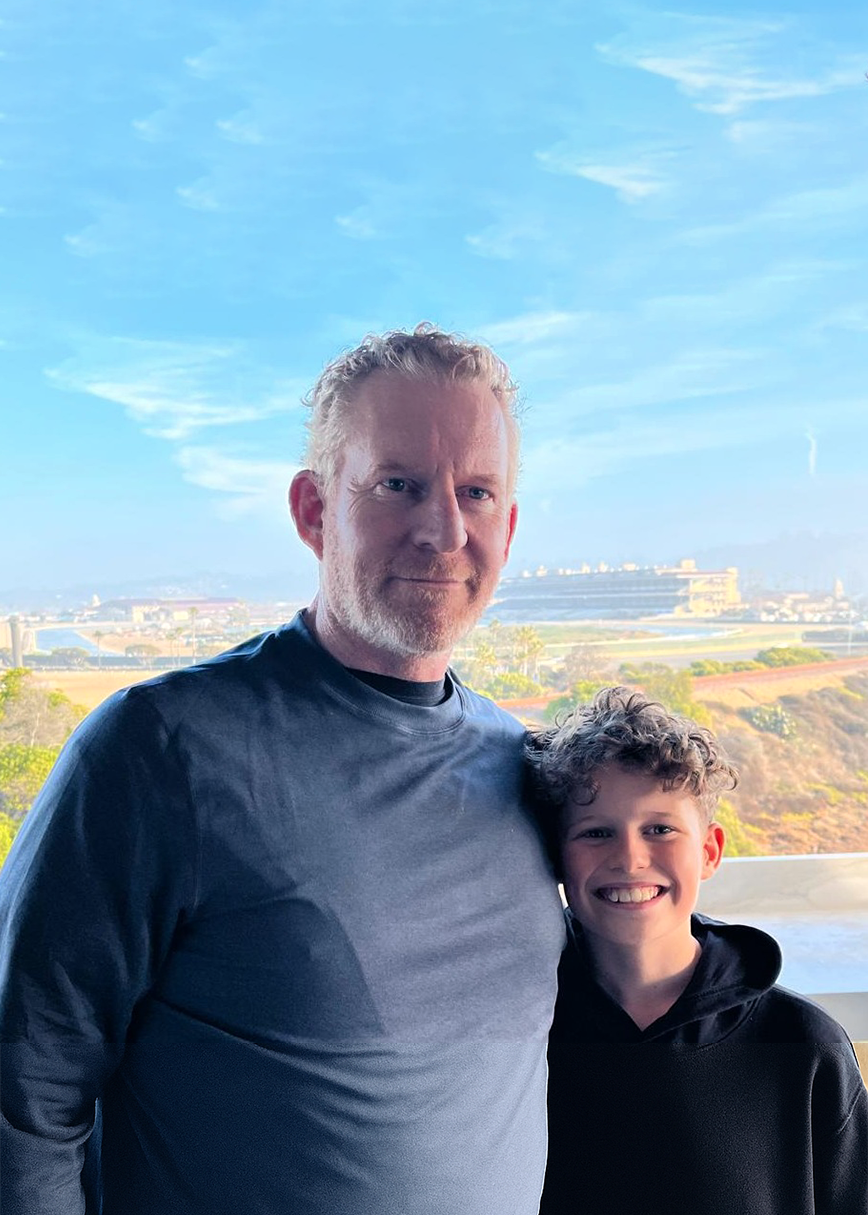
Francis then became part of building Joey Family with me. He learned coding, brought his graphic-design skills to it, did product research and, most importantly, added the teenager’s point of view to something that could otherwise very easily have been designed entirely around a parent’s anxiety.

They're trying to work out whether their child is okay.
That simple question shaped Joey Family from the beginning.
That has probably influenced the product more than anything else. I naturally ask what a parent might need to know. Francis’s view is pragmatic. When Kelly and I asked what he thought about online monitoring tools, he said that, as a 13-year-old, he knows he cannot see every danger on the internet. If technology can help keep him safer, he sees that as part of what parents are there to do: keep an eye out for him, help protect him and teach him how to navigate the world.
For me, a better product should support parents in doing exactly that: spotting risks, helping keep their kids safe and teaching them how to navigate the online world.
What I think parents should take from the article
I would not read Kelly’s article and conclude that parents should throw out every parental control. I use technology with Francis and I think there are real situations where parents need help seeing risks that would otherwise be invisible.
What I would question is the assumption that more surveillance automatically means more safety.
If I am choosing a parental monitoring product, I would want to know how often it gets things wrong, what my child knows about what I can see, whether it gives me useful context rather than isolated alarms, and whether it is helping me have better conversations or gradually replacing those conversations.
I would also ask the most basic question: what evidence is there that this actually helps?
Those seem like reasonable questions for an industry that is asking parents to hand over an extraordinary amount of information about their children.
One of the phrases Kelly used from our interview was my description of the parents Francis and I are trying to help. I said they want to be “guides and learners.”
“Guides and learners”
I still think that describes it pretty well. I am not going to understand every part of Francis’s online world, and the older he gets, the less sensible it would be for me to try.
What I do want is enough information to notice when something genuinely matters, enough understanding to ask a useful question, and the sort of relationship where he will still talk to me when I do.
MIT Technology Review asks whether child-monitoring apps might need a reboot. After using quite a few of them and then spending the last couple of years building Joey Family with the kid on the other side of the equation, I think that is exactly the conversation the industry should be having.
Sources
MIT Technology Review, “Child-monitoring apps might need a reboot”, Kelly Clancy, August 2026 Used for the analysis of parental-monitoring product reviews, the evidence on reliability, privacy and trust, the discussion of resilience-based approaches, and Grant Callaghan’s comments about Joey Family.
Joey Family, “A social media ban is not the same as keeping kids safe” Tone and editorial structure reference for this article.
Joey Family, “As a parent, why I created this app, Joey” Background on the early experiments that ultimately developed into Joey Family and the How’s My Child? Report.
Joey Family, “My Bark review for iPhone: why I stopped recommending it” Background on Grant’s experience testing parental-monitoring products and false alerts.
Related features: How’s My Child?, Smart Alerts, Contact Verification, Explore Kezza.
Read the free Spanish-language version of the MIT Technology Review investigation.